That’s right, folks. You do NOT have to clean your brushes after each use.
And it’s the best news ever.
We all know cleaning paint brushes is time consuming and messy — especially if you are painting with oil paints. But with these tips you won’t have to clean your oil paint brushes at all all! Seriously!
I had been painting a year before I learned this trick, and it’s been a game changer. Just one more reason oil painting is the best!
Tip 1: How to keep your oil paint brushes from drying out overnight
At the end of your painting session, just dip your brush into an artist-grade drying oil and lay them flat. They should be fine for a day or 2, because oil dries slowly.
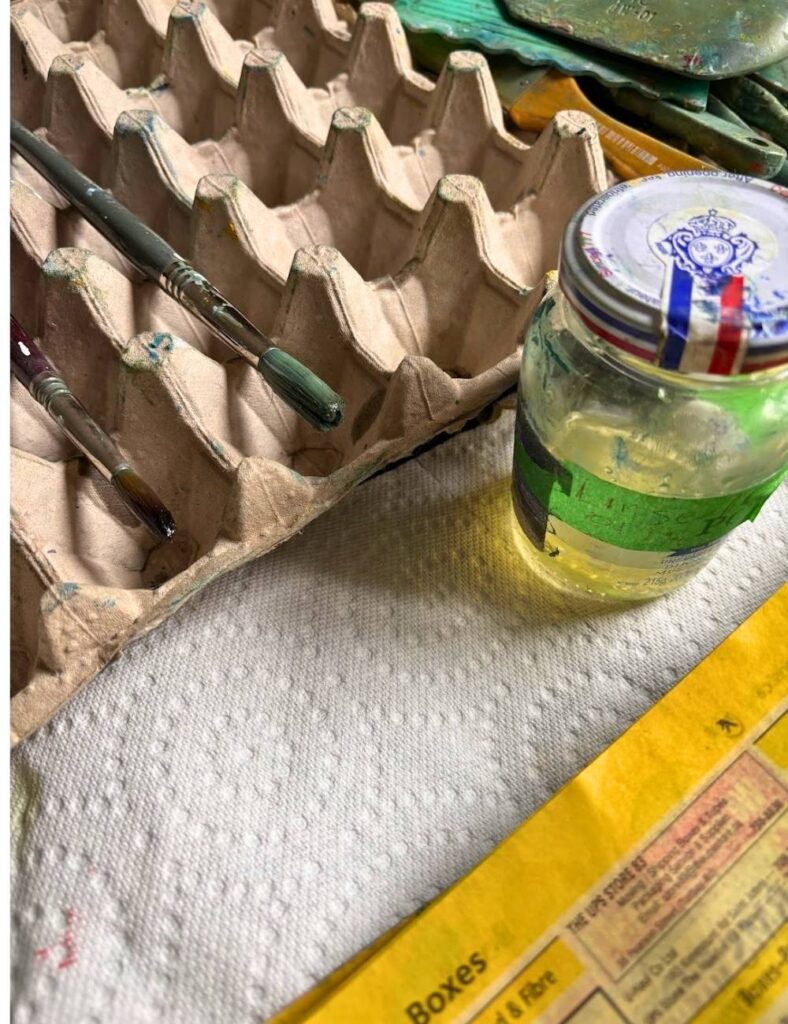
Yes, my brush tray is just an egg carton. Works great! ( And yes, that is a yellow pages phone book. The pages are thin and absorbent so I use it near my water/OMS jar to sop up extra liquid, or to get rid of extra paint on my paint brush. I have a bunch of these saved but each one lasts me years!)
You can use any drying oil: linseed, walnut, safflower, or poppyseed oil. These are the oils that are used to make oil paint, so there’s no problem if they get into your painting as long as they are refined, artist-grade. Drying oils are also used as paint mediums — things you add to paint to change the flow, sheen, drying time of your paint.
When it comes to the types of oil, linseed oil is the fastest drying (2-4 days), and poppyseed oil is the slowest (7-10 days). Walnut and safflower oils are about 4-5 days.
You can also use a brand-name oil painting medium, but make sure it isn’t fast-drying.
The next day, just wipe off the excess oil and start painting.
Note: You want to make sure it’s artist grade because you don’t want impurities to get into your art. This is most important for professional artists who need their art to last a long time.
Warning: Don’t go too long, or the paint will dry hard on your brush — just like it does on a canvas.
Bonus:
Tip 2: How to Store Oil Paint Brushes Long-Term in a Vat of Oil
This is my all-time favourite oil painting discovery: you can ditch the cleaning altogether and leave your bristles suspended in walnut or safflower oil.
At the end of my painting session, I wipe off the excess paint on my brushes and place them in a vat with the bristles suspended in the drying oil. When I am ready to use them, I just wipe the excess oil off, and start painting again.
I haven’t cleaned my brushes in years!
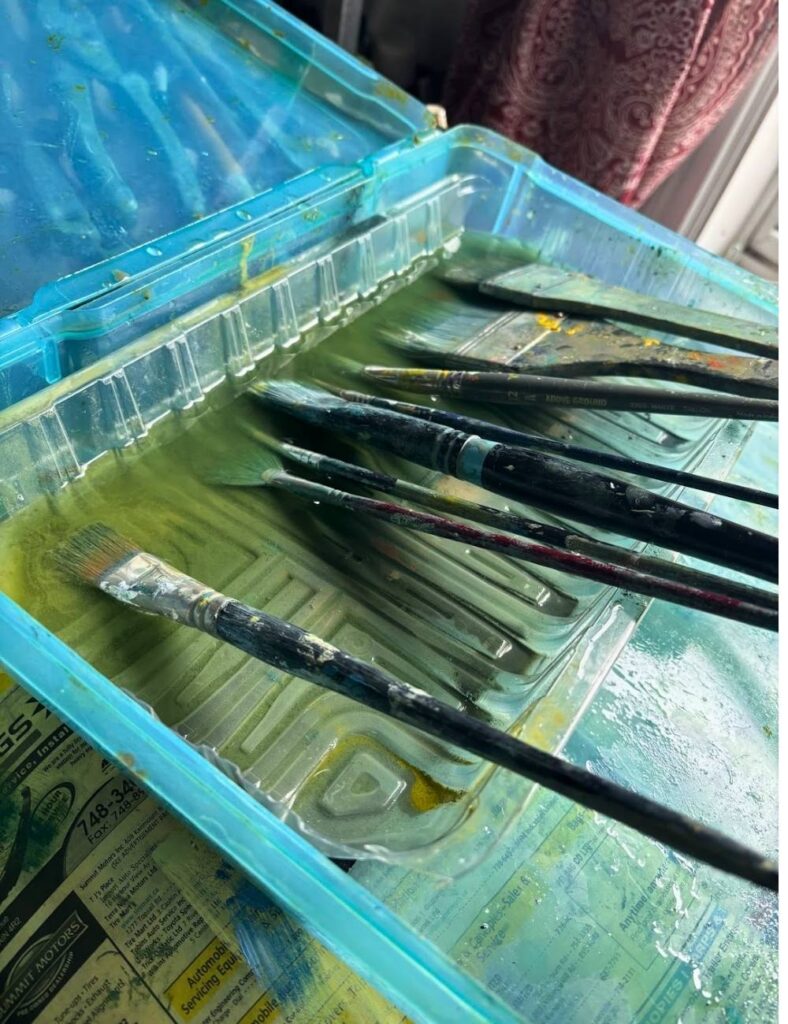
What’s beautiful about this painting tip is that you don’t have to worry about your brushes at all. As long as the oil does not dry out and the bristles are submerged, they will be fine.
Just make sure not to let the bristles jam up against the edge or they might lose their shape. And top up the oil when the level gets low.
How to Make a DIY Oil Paint Brush Storage Vat
My vat is usually a plastic food tray from something I bought at the grocery store (a vegetable or frozen food tray). And I placed that in a larger plastic box to catch drips when I lift the brush out.
You can use anything that is impermeable to oil. I’ve used a plastic roller tray before — the kind you use when you are painting your walls with roller brushes. This worked fine, too.
A slow-drying oil is best so I recommend safflower or walnut oil. Poppyseed oil is almost twice as expensive as walnut oil— so probably overkill for the vat. I’d just use it for the overnight dipping method.
You don’t need to use the most expensive or premium brand for your vat either, but do use art-grade so you don’t have to worry about it getting into your art.
I have used walnut and safflower oil, both worked fine. I’m using safflower oil now because it’s cheaper than walnut oil, and my vat stays liquid for over a year!
When the oil gets gummy — and it will — you can just replace it with a new tray filled with new oil.
Some even say this even conditions the brushes and keeps them from drying out.
Genius.
#DumaDoArtTip: If your brushes do dry with oil paint on them, don’t worry: I have revived my brushes with Winsor Newton Brush Restorer — it’s very quick. But I have also used regular old Murphy’s Oil Soap, too — it’s much cheaper and non-toxic but it takes days to work.
Love these tips? Then you’ll love my Itty Bitty Intro to Oil Painting course
It’s designed to get you up and painting in the shortest time possible with the least expense, because that’s where all the learning — and fun — is.
Inside, you’ll learn by painting mini paintings you can finish in about 30–90 minutes, so you can build skills without needing a giant block of time (or a giant block of courage).
My specialty is teaching real fine-art fundamentals in plain English — no jargon, no boring drills, no overwhelm. Just you, some paint, easy-to-follow-steps, and a finished painting in an hour or two!
Learn more & start painting here >> itty bitty Intro to Oil Painting Course
Hi Irene,
I found this information very interesting and will try leaving my oil brushes in oil instead of cleaning them. However I would like to know where you buy safflower oil? And does brush cleaning oil need to be artist quality?
Thanks,
Pia
Checking the arc raiders spielerzahlen lately shows just how many people are actually grinding for Legendary gear right now. The competition at extraction points is getting insane because the lobbies are always full of high-level squads. If you want to survive these crowded raids and secure your gear without getting wiped, you should definitely use this arc raiders spielerzahlen gear guide. It’s the best way to stay ahead of the pack.
Choosing between the arc raiders starter deck, goalie deck, surgeon deck depends on your preferred playstyle, but they all require high-tier equipment to be effective in the endgame. A surgeon without legendary defense is just a liability during extraction. To bolster your chosen role, visit the arc raiders starter deck, goalie deck, surgeon deck shop here. It provides the elite armor and weapons needed to make your build truly dominate the surface.
Hong Kong and Taipei RP names get mixed up constantly. When I specifically wanted taiwan gta server, taiwan gta server made it clear which city server I was joining.
My artist asked for a reference, not a Pinterest dump. I mocked the cover here first: how much is tattoo removal. Worth a look before you commit to the needle.
My team asked for a shortlist, not 40 tabs. I started from designeer how to make product demo videos. Worth a look before you pick a library.
If you are comparing tools, skip the still photos. I tried it live here: ai for tryon.